by Jake Wasson | Oct 21, 2023 | Season 3, Wilderness Security Guide
Welcome to The Earth Show humans. I’m Jake the Human Host (Owner/Operator) of STORYSOLD: Pest Control. This is a special live action story about one of The Show’s hardest working wilder creature friends, the beaver.
Some human sometime called the great land body territory of Oregon, “the beaver state.” Probably because of all the beavers. As a child, I read many books about wild animals and beavers. In school, I read more books about wild animals and beavers and passed many tests about wild animals and beavers. I graduated from a university entity (OSU) that identified Itself as a beaver. My uncle who graduated from a different university entity (U of O) that identified as a duck. He called me a “beaver.” Not so long ago, when Farmer Emily and I were caretakers at the Headwaters Farm, I lived within a stones throw from many beavers. We knew they were there. At night when we walked across the road with the culvert that crossed the creek, every once in a while we heard them go “sploosh” as the dove back to the safety of the water. All that’s to say, it seems that I should know beavers by now.
Yet, age 45, I’ve never seen a beaver in the wild. Even more tragically I’ve never tried to read The Earth Show for signs of beaver. That realization dawned on me slowly. I thought about the countless images and words I’ve read about beavers, and then I thought about all the times I could have, but didn’t try to read The Earth Show for signs of beaver. At first, I doubted that reading about beavers in the wild was something that humans do. Maybe we humans were meant to relate to beavers in our strange schizo-Disney way? Maybe the real beavers were the ones in the books, and the fake beavers were the ones who lived a few miles outside my front door in Johnson Creek?
Instead of sinking further into despair (and weeping over my complete lack of education as a graduate of Beaver University), I asked Emily for a reality check. “Of course humans read The Earth Show for signs of beaver,” she said matter-of-factly. “They call them surveys.”
“No shit,” I said with amazement. “Sign me up. Let’s do one of these whatever they’re called surveys.”
Understandably, the entity who identifies as “The Johnson Creek Watershed Council” doesn’t advertise the recreational reading of wild beavers. Instead they pretend to take it very seriously. You know, data collection for science blah, blah, blah.
The survey began a few weeks later. STORYSOLD: Pest Control already had a wilderness guide, so naturally our live action character Wilderness Security Guide felt strong feelings of competition when the youth named “Marlee” was introduced. Marlee’s pronouns were they/them; which we related to, because we identify as a “they” and or a “royal we” in our legal state ordained hosting of the business entity known as STORYSOLD: Pest Control. The Council identified them as a “Community Outreach Coordinator.” In short, Marlee wasn’t as good a guide as Wilderness Security Guide would have been in her place, but they were still awesome in their way. We couldn’t think of one bad thing to say about the youth’s production of The Earth Show: The Part Where The Johnson Creek Council Produces a Beaver Survey Adventure for Full Cellar Farmer Emily and Jake Son of Storysold.
Our adventure began with a zoom meeting featuring a general period of instruction about beavers, an overview of the survey objectives, and the fake meeting ended when we chose our survey section of creek and exchanging contact information with our teammates.
I was generally bored by the fake meaning, but I did happen to collect some cool facts: a) beavers build piles of wood for the express purpose of marking them with their scents; b) beavers eat their own poo poo, because bark is hard to digest; c) beavers don’t live in dams, they live in lodges near the dam; and d) beavers are known as “keystone species” because they control, shape, and build the environment that other species depend on.
Note the use of Marlee’s schizo-Disney beaver to help us relate…


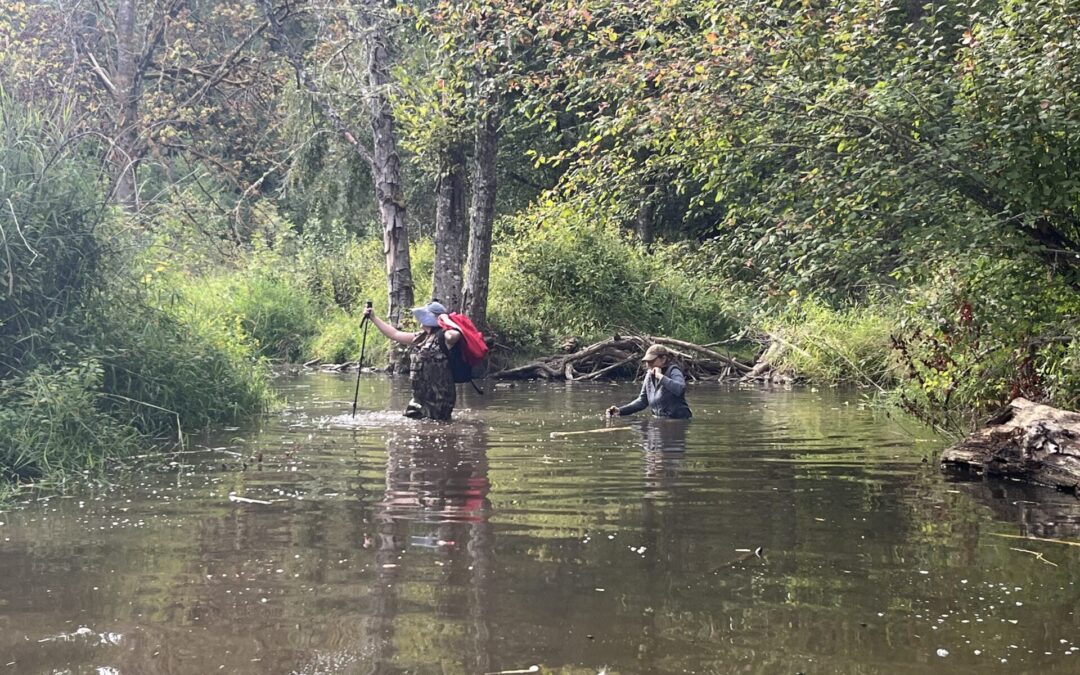
After the fake meeting concluded Farmer Emily and I drove to Tideman Johnson Natural Area in SE Portland to meet Marlee and our fellow surveyors for real. We’d signed up for a mile long stretch of the creek between Gresham City park and our farm in Boring, OR. Our teammates (sisters named Rebecca and Laurel) couldn’t make the meeting that day, so we picked up their gear for them.
The organizational meeting was as expected: awkward engagement of strangers followed by strange safety rituals. The Council issued us fishing style hip waders and trekking poles, and then divided the surveyors present into two groups. The first group gathered with Marlee to learn about proper data collecting practices and gear check the backpack issued to each team. The second group was asked to do a dress rehearsal: put on their waders, grab their trekking poles, and practice walking for real in the creek. When it was my turn to put on the waders, I took a long look at a handsome older homeless man with bad teeth and a long beard who was doing chalk art on the concrete supports of the bridge we were standing under. He was doing art, but he was also watching our show. The man without his shirt on basking in the sun looked back at me with an amused smile that seemed to say, “Go on pet. Put those stupid waders on like a good domesticate and join The Civilization Show.”

Using my unspoken man telepathy, I reminded the homeless chalk artist who I identified himself as “Banksy on the Bank” (via telepathic communication) that I wasn’t a full blown domesticate. I was a rat catcher, wildlife eviction magician, and I’d thru-hiked the Pacific Crest Trail one and a quarter times. In other words, I had a lot of experience doing dumb things in The Nature like being swept down raging creeks in springtime because I tried to cross at the wrong log. So yeah, my pride didn’t allow me to wear the waders that day. But I did take advantage of the socially appropriate time to creek walk down Johnson Creek with a group of other humans. It was fun. I got wet up past my knees, tracked The Action of crawdads, and tried and failed to make intelligent conversation with a fellow surveyor I followed up the creek.
I’ll be honest. I drove away that day like non-believers leave church (as fast as possible). I was certain I’d been swindled into participating in some kind of safe structured funtime adventures. I was not okay with that. I was not one of those domesticates who do karate classes, tour National Parks in buses, take zip line ecotours in third world jungles, grunt at other humans in workout gyms, or participate in primal screaming (or other herding rituals) at rock shows. Scenes like those don’t fit well in my story. I felt strange and out of time-and-place doing any of those comfortably safe “activities” humans do to satisfy their very real need for wildness in their lives.
Wilderness Security Guide was the first of us to make words of that feeling. “I’m a pro rat catcher,” Guide grumbled as we drove home that day. “I have a feeling I’m going to discover more wildness in one of my customer’s crawlspaces than this survey.”
And I felt that way until I met Rebecca and Laurel on the day of the survey. My first spark of adventure hit when Laurel, who had her own camouflage waders and creek walking gear, calmly waded into Johnson Creek up to her waist as she described surveying the same stretch of creek with her sister last year pregnant. I clearly read it as a boast, which I valued. Adventurers all boast, because all adventurers love victory. There’s no point of winning and reaching the end of an amazing adventure, if you don’t share the story with anyone and everyone you meet later in The Action of The Earth Show. The word “boast” is only bad when the storytelling is produced badly, or reenacted without the proper style that inspires others.
In other words, I liked Laurel and Rebecca immediately. They were chalk full of life, adventure, and the kind of live action writing style that inspired the best in us to be better.

On the other hand, I (being who I am) was still engaged in an unspoken manly telepathic conversation with Banksy the Bank. My costume for the day was shorts, old shoes, T-shirt, sunglasses, STORYSOLD brand ball cap, and my man satchel slung high over my shoulder. I liked the way the creek felt. Its story was cold, slimy, wild, and alive.

As it goes with all of my adventures, a soundtrack slowly began to emerge as we make our way up the creek in search of Beaver signage. The winner was, “Adagio for Strings Op.11,” which was made famous in Oliver Stone’s war drama Platoon. The movie was about a young man who learns to face death in the company of other men participating in the modern coming-of-age ritual known as war.

I had to stop and appreciate the meaningful difference between our survey and the movie Platoon a few times. Instead of facing death in the company of men, I was facing life in the company of women. I have to say, it was refreshing to track a good earth creature in an effort to support their story. It made more sense than tracking down bad earth creatures to kill them because we were afraid of them. Imagining the worse in The Action at every turn is not fun. It was so cool to discover signs of beaver all around us!

As instructed by Marlee, we stopped at every dam and recorded the data. Which meant breaking out the tape measure, the signage board, and the camera. Laurel took most of the photos, because she had the app in her phone which she used to download the data.


Here’s a smaller dam that didn’t have a lot of signs…

Here’s larger dams that had signs of beaver all over…


And here’s some shots of the lodges, or beaver homes, we found mostly along the banks…

Note the smooth mud trails known as “slides” where the beavers enter and exit the water on the regular…

I think the part where I waded across the creek in chest high water was the moment I decided this was a proper adventure. I was so wrong about Johnson Creek. It didn’t disappoint. As we moved slowly through the water we had to navigate windfall, dams, homeless camps, nettles, blackberries, thickets, and you name it! Signs of life were everywhere: crawdads, coyote trails, raccoon dropping on the logs overhanging the creek, song birds, little fishes, freshwater muscles, and the blue heron we kept chasing up the creek….

Four hours later, we’d collected data on something like twenty one dams in our mile long bushwhack up Johnson Creek. By the end of our adventure I was beginning to feel uncomfortably cold. I never imagined it would take that long.
“So that’s why Laurel and Rebecca brought their own waders,” I grumbled to myself.
No matter. I was happy. Proper adventures are rarely comfortable in scene. I like to think the cold, and the heat, and the rain, and the bugs, and all the uncomfortable feelings that happen when we humans engage The Earth Show for real have a purpose. Uncomfortable (pesky) feelings are The Earth Show’s natural mnemonic. All the wilder extremes help us remember better than any test administered by teachers in the climate controlled environments of schools. To point, I’ve forgotten almost everything I’ve ever been tested on in school, but I will remember the signs of beavers I read that day.
“Huzzah!” I cheered when I finally felt my toes again. “I was so wrong! Participating in wildlife surveys is an awesome way to read and remember and engage the wilder creatures of The Earth Show.”
It was much better than any book I’ve read on beavers, even though I still have never seen a beaver in the wild. I like to believe that one day, when I least expect it, I will meet my beaver. And the soundtrack will be Adagio in Strings Op. 11 from Oliver Stone’s movie Platoon.
No doubt the wild beaver will be doing his best impression of William Defoe to seem more real to humans. I mean, seriously all he’s missing is the big front teeth, fur, webbed feet, and a large flat tail.

For more info on proper life facing wilder adventures check out: Johnson Creek Watershed Council

by Jake Wasson | Aug 15, 2023 | Season 3, Wilderness Security Guide
Welcome to The Earth Show humans. I’m Wilderness Security Guide the Environmental Control Operator for STORYSOLD: Pest Control. This service story is about the time when I caught a bat in the rural wilderness that was a suspected carrier of rabies.
Seven thirty AM on a Sunday morning STORYSOLD: Pest Control received the following phone message from a familiar vacation rental manager. One of the properties, which we’d produced rodent, carpenter ant, and bat services for in the past, was under attack.
VACATION MANAGEMENT: We have guests staying at the house [in Brightwood] and there is a bat in the house and they are all freaked out. They really want someone with your expertise to come get it. Also, it sounds like we probably need to set up the same thing that you did last year at that property. Hoping you can give me a call back because the guests are frantic. [Break] I don’t even know if it’s possible for you to capture this thing and hold onto it for a couple hours until I speak with my office. This lady keeps going on about wanting to have it tested for rabies and how the country does testing etc. I don’t want you to have to deal w that part of course–but if my company decides to appease this lady once I can get in touch with them in a few hours…if the bat is still in the box or something. So dumb…but just let me know if “capture” and hold is possible.
STORYSOLD: Let’s start with finding out if I can catch it.
I used to feel like a super hero when I got calls like this. Now that I’ve been doing this for a while I’ve learned that most “pest emergencies” are mostly fear management/mental health emergencies in disguise. Luckily, our human Jake hosted a mental health character (a case manager) in Enterprise, a small town in eastern Oregon, in one of his many former employments. Small economic depressed towns being what they are, our human’s role wasn’t strictly case management. He was also an out patient med aid, urine sample administrator for a substance abuse counselor (the whizinator), group therapy leader, work crew (vocational rehab) coordinator, social/educational activities director, crisis transporter, and a part of the county’s three person mental health crisis team. So, in other words, I grabbed a box and a thick pair of gloves and put my mental health pants on.
Thirty five minutes later, I was knocking on the door of the cute vacation cabin in the woods.
The SUV in the driveway had California plates, which is meaningless information for most, but I’m from Oregon. I have learned to fear Californians for many reasons. High on that list is, Californians tend to host a character that both loves and fears nature. It’s a wilderness version of the classic “Not in my backyard!” character most of us know well.
For the record, I’m aware of my irrational bias. I receive regular treatments from friends and family (and especially my partner Farmer Emily) to help me deal with my irrational fear Californians.
The husband greeted me at the door. The wife, newborn baby in arm, hung back within earshot of the conversation with the other children. He was pleasant and receptive to my initial prompting.
STORYSOLD: Is the bat still trapped in bedroom?
HUSBAND: Yes we closed the door and put a towel below the door.
STORYSOLD: Perfect. Let’s see if I can catch it without turning this into some kind of dramatic Tom and Jerry scene.
He seemed to appreciate my light tone and attempt at humor. A moment later I marched in with my gloves fitted tight like a good soldier–ladder and box in hand–prepared to face the creature. A minute later I returned with a bat in a box.
STORYSOLD: He’s so cute! I found him roosting calmly on the wall.
HUSBAND: Oh great! Thank you so much!
Now that I had the bat safely secured, I decided it was a good time to try my luck with a Coming To Jesus Moment. Still smiling, still speaking in calm/high frequency tones, I provided the parents with some backstory to help them understand their wilder encounter.
STORYSOLD: I get a few calls like this every bat season. What usually happens is, a bat flies in an open window (I mean, it’s summer and it’s hot and people tend to leave them open) and then it gets trapped. This cabin has vaulted ceilings and lots of placing to roost, so it might have been trapped inside for a while before it flew into the bedroom. That would explain why our guy didn’t attack me when I grabbed him. I simply brushed him into the box. I know lethargy is one of the possible symptoms of rabies, but it’s just as possible that it’s starving to death. [Long pause] I remember last summer I was doing an epic bat eviction and exclusion in Boring and the homeowner called me in a panic, not from his home, but from his friend’s home. A bat had flown in and he wanted to know what to do. I coached him through it, and a half hour later he sent me this awesome photo of him smiling with his captured bat in a storage bin…

The husband didn’t respond to my attempt at conversation. Instead he delivered his preloaded lines expressing a desire for the same outcome they wanted before I said word one.
HUSBAND: The bat was in the room with our baby for two hours alone…And one of our children has scratches on his nose…
STORYSOLD: The bat attacked your child?
He paused, knowing well his wife (baby in arm) was watching and listening in.
HUSBAND: Oh you know kids. They could have got the scratches anywhere…and we didn’t see the bat attack them…but our baby was alone with the bat…and we’d like to have it tested for rabies.
I greatly appreciated the effort he was making not to lie. It immediately brought some calm to my irrational fear of Californians.
STORYSOLD: Huh. So you didn’t see the bat attack your children?
Long pause. I decided not to ask any more pointed questions. Instead I attempted, once again, to guide them through their engagement with the wilderness. I took Husband outside and showed him the bat box I’d hung last season, sharing the service story about the time I found bats roosting in an open entry hole (created by a fire at some point) around the chimney. I explained how I’d evicted them from that void and blocked off the hole with metal flashing, then put a bat box there in an attempt to give the bats a better shelter knowing well they would likely return the next season and find somewhere else to roost. The idea being it was better to try and control their population in a wilderness area where bats were always found instead of neglecting their needs. And sure enough, there were signs that the bats had been using the box. I also explained that it wasn’t easy to persuade any wilder earth creature to do what we humans want them to do, explaining that bat boxes needed to be put in active areas for at least a season or two before they were moved further away.
SIDE NOTE: If you reread the opening lines from the vacation rental manager you’ll note that she believed that box was designed to capture and or kill bats. Last year I wrote a detailed action plan for them, but it’s a big company with many contact people. I don’t blame her for not understanding that. One of my lifelong mantras has been, “If someone doesn’t understand what I say, it’s usually not their fault. Failure to understand is, in most case, is the product of bad writing/communication.”

I hate when humans monologue (especially teachers, employers, and self-proclaimed experts), so I kept my period of instruction short. After I showed them the box, we gathered on the front porch where I did my best to listen to them.
MOTHER: Oregon Health Authority has a number you can call for rabies testing. If you don’t want to do the testing, you can give the bat to us.
STORYSOLD: I don’t feel comfortable giving you the bat.
MOTHER: If you don’t test the bat, we will all have to be tested for rabies.
STORYSOLD: I know that would be expensive.
MOTHER: I have the number you can call for the testing if you want it.
I tried to hint that maybe the bat didn’t have to die. But the frightened parents continued to hit the reset button back to the beginning of the only service storyline they were interested in: TEST FOR RABIES….TEST FOR RABIES…TEST FOR RABIES.
STORYSOLD: In all the years I’ve had a wildlife operators license, I’ve never had to test a bat for rabies. Mainly because I’ve never encountered a bat that attacked humans.
As I shared my stories and listened to the parent’s reset variations of TEST THE BAT NOW, I was also processing my fears. I knew, from experience, that one of the many symptoms shown by a human, or animal, whose been infested with fear is what I call, The Clinging. Or the clinging to old familiar and or easy to digest new ideas. Maybe I was the one experiencing irrational fear, not them? Maybe I was wrong about the Californian character and other colonizing characters like them? Maybe Californians weren’t a plague of invasive pests feeding off Oregon’s indigenous homefronts by turning them into Airbnbs and high price rental investments? Maybe that was simply situation normal in a state where territorial homefronts were weakened by decades of poverty.
After a few moments of processing my fear, I was calm enough to do dust off the part of my brain that runs The Numbers: a) it was normal for all parents (human and animal alike) to feel a heightened sense of fear/need to protection for the well-being of their offspring; b) I had no doubt the parents would test themselves if I didn’t test the bat (and that would be expensive for the vacation managers/owners if they asked them to pay for it); c) I was a wildlife operator, not a vector control expert (clearly); d) I had no way of knowing if the scratches on the older child’s nose were inflicted by the bat and I wasn’t going to play doctor; e) I had no way of knowing if the baby had been attacked and bitten or scratched and I wasn’t going to play doctor; f) these Californians were staying calm and rational and willing to work with me in spite of my attempts to save the bat’s life; g) the incubation period for rabies is 3-5 weeks, but there has been case as long as seven years (that’s a long time to read The Action and wait to know if your baby is safe); h) sometimes John Wayne is right: the bad guys have to die in the end to save the day.
When I was done crunching The Numbers, the math read: A + B + C + D + E + F + G + H = the bat had to be euthanized, have its brain cut open in a lab, and tested scientifically to make certain we weren’t misreading The Action.
STORYSOLD: I understand. I’ve never had a bat tested, but I will figure it out even if the management company decides not to pay for it. My guess is that they will. That seems like the best course of action to me.
Then we exchanged information and I drove off with the bat. After I stopped at Safeway to buy a few donuts and bananas for breakfast, I asked the oracle of the internet to guide my next step. It had a lot of information for me to process:
https://www.oregon.gov/oha/PH/DISEASESCONDITIONS/COMMUNICABLEDISEASE/REPORTINGCOMMUNICABLEDISEASE/REPORTINGGUIDELINES/Documents/rabies.pdf
One of the more interesting things I learned was, Oregon’s Health Authority only tested bats that had been exposed to bat saliva, or possibly exposed to bat saliva.
My next step was to call the rental manager, who’d been waiting patiently for word. After I shared the story with her, the first thing she said was, “She [the Mother] didn’t say anything about the bat attacking and scratching her child.” I bypassed that part of the conversation. Instead I pitched her The Numbers marked in bullet points A through H. She seemed relieved to have a plan, and agreed that we should had the bat tested for rabies, but she’d have to get back to me about payment.
It was Sunday, and the Oregon Health Authority wasn’t open for its usual business of authorizing our collective health. At that point, I was still in denial. I was horrified by the idea of having to kill my new bat friend. He or she was very cute. The earth creature didn’t infested me with fear. Instead its presence triggered my many wilder encounters with bats. I remembered our honeymoon when we sat on a rock along the Green River in Utah and watched a cloud of thousands of bats feeing on bugs in the twilight. Long before The Fourth Wall stole the bat’s character and made it an agent of fear in nonsensical fictions like Batman, the super real bats of The Earth Show were heroes–especially for me. As a lifelong backpacker, I hate mosquitoes more than any earth creature. And as the wise old saying goes, “The enemy of my enemy is my friend.”
That’s why I did my best to make my new friend comfortable.


I had a ten hour “emergency” crawlspace clean out and exclusion on Monday, but I managed to call the authorities before the Californians texted me wondering worriedly if I had indeed followed through with what I’d said I would do. I expected to navigate a mountain of bureaucracy, but that didn’t happen. Instead I was met by a wonderful human on the other end of my phone. Her name is Renee and she was the nurse in charge of dealing with Oregon’s health emergencies.
She was great. I don’t know what else to say. She called the Californians, got their information, and made arrangements with a private vet in Oregon City to receive the bat. She didn’t expect me to deliver it, but was appreciative when I volunteered to make the trip first thing in the morning.
The private vet under contract in Oregon City was another story. They took one look at me and my bat and promptly charged me a bunch of money.


As I stood on the customer side of the service counter I, being who I am, promptly engaged the nicer customer service specialist in a debate about the benefits of bird feeders. As we chatted amiably, I overheard the less nice specialist complaining, “Another one compliments of that contract…”
I paid the humans at the center for domestication (aka vet) and said goodbye to my bat friend. Later that day, Renee checked it to thank me for my help. I was feeling the loss of the bat. I almost cried it was so nice. And it burned me to think that the vet might be double dipping on their contract. I knew from years working in the government, a private company under contract gets paid by the contract. They bill the government at the end of the month. They don’t bill twice for the same service. So I sent Renee a copy of the bill and asked her if that was normal.
She immediately called me, assuring me that my money would be refunded. In retrospect, I realized that I might have done something to harm our economy. You know, like pirating movies. I could have easily passed that $235 bill onto the vacation management company. The economy could have been $470 dollars more confident with two businesses cashing in on one government contract. I almost felt wrong for that one. Harming the economy isn’t a victimless crime!
I know what happened next. The double-dipping private vet (center for domestication) euthanized my bat friend, boxed them up, mailed them to OSU’s lab, and the scientists there sliced the bat’s brain open and performed their rabies test.
I know what happened next, but I’ve decided not to publish that part of this story. Mainly, because I want you, dear reader, to feel the fear a little. One of the hallmarks of dealing with wilder earth creatures who live in The Action outside of our civilization is dealing with the many unknowns they present us. We built The Fourth Wall–the many screens, books, theaters, podiums, game boards, ritual sports fields, and customer service counters of civilization–to protect us with a veil of concrete black-and-white fictions that makes us feel more at home in our homes.
Bats don’t have that luxury. They’re out there living hard in the super real of The Earth Show. That’s their super power. They are who they are in spite of the fictions we project onto them with our fear infested stories.
I feel good about my role this earth show. I don’t hate all Californians (most days) and I don’t love all bats. I believe it was necessary to kill and test the bat, so the Californians don’t have to live in fear of a very real disease. What I hate (all the time, every day) are infestations, especially those that are breed by the old familiar post industrial Descartes mind/body split (and or concrete classic religious good/evil division) dualism that preys on human fears.
Five days later, on the hottest day of the hot days in August 2023 (105!), I received another call from a worried homeowner in Gresham. She reported that a bat had taken roost beside their AC vent above the bar in a room with a vaulted ceiling where they often left the door open. There was no mention of rabies. Only the super real realization (knowledge) that their neighbors had recently relocated some bats. An hour later, ladder and box and gloves in hand, I was in The Action attempting to capture another bat. This guy was a lot more wily. I stood beside the bar, in the middle of the room, watching our bat friend fly circles around me for a few minutes while I unsuccessfully tried to catch him. All the while I was thinking, “Damn this guy is smart. I wish I was belly up to the bar, drink in hand, with air conditioning blasting in my direction.” And yes, that’s what I was thinking about when I was watching the bat fly circle around me. “Damn my Adventure in Sobriety!”
Resized_20230814_075051.HEIC
A few short minutes later, I’d captured the bat. And it was pissed! It screeched at me when I stuffed it in the box (using thick leather gloves) and it continued to fly and screech at me all the way home.
It was not a cute lethargic bat. It was a very angry wilder bat.
Nevertheless I was determined to make friends. As soon as I got home, I put it in the same cage I’d fashioned for the other bat. Then, when the earth cooled and the sun was sinking, I volunteered Farmer Emily for what became Full Cellar Farm’s first ever attempt at hosting bats.

He was still in there when we went to sleep that night. And that made me feel good.

Every once in a while I win one…
by Jake Wasson | Jul 13, 2023 | Season 3, Wilderness Security Guide
Welcome to The Earth Show humans. I’m Wilderness Security Guide the Environmental Control Operator for STORYSOLD: Pest Control. This service story’s about the time we met our ideal customer. Her name is Katherine, and she engaged her Homefront in ways we imagine all future human hosts will engage the wilder sides of The Earth Show…
< OUR FIRST EMAIL FROM KATHERINE >
In 2020-2021, we had roof rats in our attic. They were pretty quiet and we kept putting off dealing with them. This fall I found that Norway rats have displaced our roof rats in the attic. It was time to act, so we sealed up some of their holes, but left two major ones open. We planned to then launch a big trapping campaign, and finally seal the remaining holes. However, before actually doing this, I got worried that because we don’t know what we’re doing, we’ll set the traps in the wrong places and the rats will get wise and will be much harder to catch. Additionally I am suspicious that there are more entry holes at ground level that we haven’t been able to find. We wanted to find someone (you!) to help us identify ALL of the entry holes, and to set traps in a more effective way than we could do.
But, if you really wanted to know ALL of our rat interactions:
Our house is pretty ideal for rats. When we moved in December 2019, the property was overgrown with ivy, cave-forming shrubs, and bushes touching the house. The house is from the 1920s with hollow, inaccessible soffits, wood has shifted, and there is a superb choice of rodent entry holes, especially in the soffits.
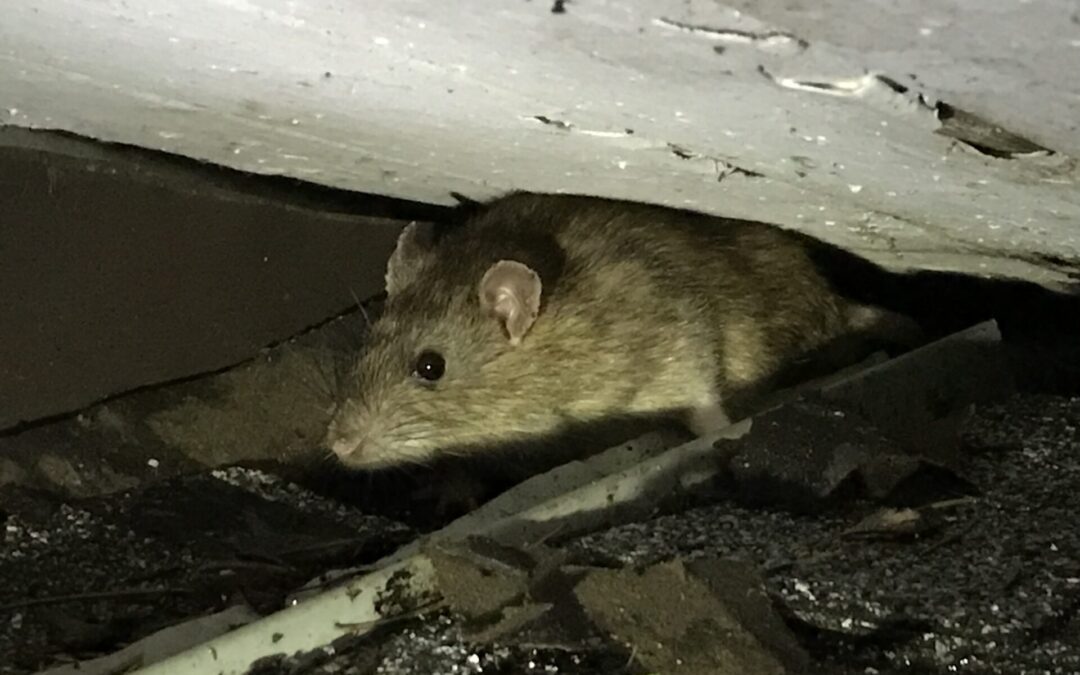
When we moved in, I explored our attic crawlspaces & found plenty of evidence of previous rodent habitation and attempts to control it by trapping and poison. This included two dessicated Norway rat corpses, a rat skeleton (Figure 1), greasy tunnels in insulation, abundant feces, gnawed bait blocks, and sprung traps (one already supplied with a dried rat). Per our 91 year old neighbor, who is an excellent neighborhood historian, people living at our house have had trouble with rats for decades. (I have the impression that he attributes this to a deep-seated flaw in our house.)
Hoping that all this was evidence of FORMER rodent activity, all we did was to limit where food is stored (no food in garage, only canned goods in basement). We gradually altered our landscaping by removing ivy, trimming low hanging shrubs, and cutting shrubs away from the house, although there are still plenty of places for rats to hide and climb. Occasionally, we would hear tiny sounds in the attic, as if it were haunted by the ghosts of long-dead rats…
One morning in spring 2020, we found our dog and cat sniffing intently at the gap under a bookshelf in the living room. Underneath, a roof rat was cowering (and also peeing). We cautiously scooped him into a box and drove him ten blocks away, where we deposited him on an ivy-covered bank behind a big box retailer next to a piece of fried chicken that we happened to find nearby. (We know that if you move a rat away from its territory it will probably die. But we wanted to “give the rat a chance”.) This happened yet again a month later. This time, the rat was hiding in a small gap under a door, also cornered by dog & cat and unable to push his way through to the other side. We figured that these rats had probably fallen through a perfectly round, 7” hole in the living room ceiling. Covering this hole appeared to dam the cascade of roof rats into our living space, but they continued to live in the attic (why would they leave?)


A Squirrel in the Soffit
That same spring, I started to hear loud grinding noises while sitting upstairs. After also hearing some running in the attic crawlspace, I entered to see a good-sized rodent staring beadily at me. The source of the gnawing was soon pinpointed to our fascia board next to the chimney, where a greasy hole exhibited fresh gnaw marks. I believe this was a long-standing rat hole and that the uproar in the crawlspace was caused by a mother squirrel, who had discovered the rats’ front door and was in the process of improving the entryway and filling the hole with camelia leaves. I began to remove the leaves, but stopped when I saw a movement towards the back. Not wanting to wall up baby squirrels, but wanting to fill the hole as soon as possible, I co-opted one of our security cameras to monitor the nest. The mother squirrel never returned. When I eventually came back to remove the nest, there was no evidence of baby squirrels (not even droppings). Did the rats eat them? Did the mother squirrel succeed in removing the babies without triggering the camera? Were they never there at all? In any case, the camera was christened RatCam and soon began to provide excellent footage of roof rats entering and leaving our attic. The camera’s night vision gave the illusion that their eyes were glowing balls of light. You might think that we would have then filled the hole, and we always meant to, but we planned to find and fill the other holes first, then set traps. We did fill some holes, but then… we stopped. To be honest, I think we put it off because we both felt badly for the roof rats, who never bothered us in any way. Every once in a while I would talk to them when I entered the crawlspace for one reason or another, warning them not to gnaw the electrical wiring. This year another squirrel tried to use the hole for a nest, but she quit after I removed some of her sticks and rubbed my hands around the hole. We don’t have the camera up anymore, so I don’t know who is using the hole, although I continue to check it for squirrels.
On a hot day in 2021, we found a young roof rat in distress (Figure 3) under our garden hose not far from a hole referred to as the Great South Rodent Gate. I imagine that the crawlspaces had reached heatstroke temperatures for rats. We considered relocating the rat away from our house, but it didn’t seem fair to kick a rat when it was down, so instead we put down some water and left. Later, the rat was gone, either recovered or eaten.
A New Rat in Town?
Then this summer, things started to change. I found a dead juvenile Norway rat in our berry patch and was also seeing more dead ones around the neighborhood. I assume that Norway rat settlers were on the move, looking to expand. Our roof rats were no match for them. In the early fall we began to hear grating and grinding noises in the walls (like a rat enlarging a hole in wood, perhaps), and periodic running in the attic crawlspace. A new rat was in town. On two occasions I was able to actually see the rats after hearing them running, close enough to recognize that they are Norway rats. The only times I have seen them is when I hear some kind of noise in the crawlspace, then go investigate. Whenever I go up just to check things out, no rats are to be seen (though they leave plenty of signs that they’re there). I’m wondering whether they only become incautious enough to allow themselves to be seen when there’s some kind of social upheaval to distract them from the need to hide. When they do see me, they don’t run unless I start to approach them. They just kind of hunker down and glare in a manner that seems pretty bold to me. But perhaps they imagine that if they hold still, I won’t notice them?

Figure 2: Representative photo of a squirrel on our roof.


Figure 3: The rat in question, dazed enough to allow close up photography.
They have been pretty good about not entering our living spaces, with the exception of a brief exploration of our basement. I knew where they were entering because there was a trail of insulation and rat feces, and because I saw one for just a second whisking back into the hole. We covered those entries with hardware cloth, swept the corners of rat feces, and I haven’t seen any sign of further basement visits.
We know it’s just a matter of time before they figure out a way into the kitchen, or set a fire by gnawing the electrical wiring. We have begun covering possible holes, but really want your help identifying more holes… and setting the traps in the best places. So, we are glad you can come!
< END OF THE FIRST EMAIL >
My initial set up service was fun. I enjoy conversing with homeowners who take an active interest in the wilderness security of their Homefronts, but “interest” doesn’t begin to describe her wilder side loving character. From the onset, I could tell she was engaged (an active participant) in the drawing and maintaining of her Homefront. She asked if she could JOIN ME IN THE ATTIC SPACE to set traps. She CLIMBED ON THE ROOF WITH ME to inspect the entry holes.
“What kind of wilder loving character does shit like this?” I thought to myself as we engaged The Action of her Homefront. “Certainly no homeowner I’ve ever met.”
“Let me guess,” I hedged as we climbed on the roof. “You’re some sort of scientist.”
Katherine smiled as she crouched down to inspect the gutter line mere inches from the edge. In an easy manor, she confirmed my suspicion that she was indeed a scientist. As we explored and make discoveries, we conversed (as scientifically as I was able to muster) about the borderland between wilderness and civilization we call home. I was wonderful (very refreshing) to talk aloud with another human about subjects I care about deeply but don’t often have anyone to converse with.
These days humans like to talk a lot about being different and often feel compelled to tell other humans why they believe they’re special, but I’ve discovered that the human who shows other humans the unusual character(s) they’re hosting, instead of merely telling, feels truly special. It’s like finding a unicorn in a herd of horses with paper horns that blow away at the first call for action. Katherine’s willingness to explore her own rat infested attic was one of those special unicorn finding moments. I meet humans who host characters who love The Rats of NIMH (and own bookshelves full of books about the wilderness), but shy away from the rats in their own attics. In general, exploring attic and crawlspaces (especially infested ones) is one of those across the board gender neutral universal fears. So much so, I remember most of my encounters with such humans. My former helper (former Full Cellar Farmer) Llew hosted a similar character. I’ve also had a few kids follow me into crawlspaces as well, which is interesting for a number of reasons. Long ago, The Pied Piper story was originally about children disappearing into the wilderness. The rats only became part of that story centuries later. I think our children are born wilder. It’s only until we expose our children to Disney and the generic stories we tell them about The Earth Show in the maddening void of classrooms do they learn to fear the world around them. It takes effort for me to relate to that fear, because I engage rats in the super real of The Earth Show almost every day. I find it bizarre (and mildly schizophrenic) that most humans host a hundred and ten generic stories about rats which they’ve adopted as the truth from their engagements with The Fourth Wall of books, school, and culture, but most humans can’t say much about the wilder encounters they’ve had with the rats that live almost everywhere in their neighborhoods. The learning process seems sort of backwards there.
But yeah, whatever. That’s situation normal for the civilized side of The Earth Show, and it’s a lot to ask any human to leave the insular comforts of civilization. That’s why, at the end of the first service I didn’t assume anything about Katherine’s wilder character. I asked her, like I ask most of my customers, what her preferred level of participation was in regard to the checking and very likely the clearing of dead rats from traps. Not surprisingly, she was game.
“I love your spirit,” I smiled as we parted. “You’re going to earn your Jr. Rat Catcher Badge by the end of this for sure.”
SOON AFTER I RECEIVED AN EMAIL FROM KATHERINE >
KATHERINE: No activity until 9:30 last night. From below your trap buffet I heard a soft clatter. In the attic, one trap had been tripped and flipped over. No other bait appears touched, except that one of the free peanuts I placed in the insulation has been moved to a different spot. We will reset the trap and keep you informed of any further developments. Thank you so much for the list of rat songs! Musicians across the world agree, there can never be too many songs about rats.
STORYSOLD: Prediction: you will catch a young rat in one of the traps in the next 24 hours.
Yeah I was wrong about that one.
I CHECKED IN AGAIN A FEW WEEKS LATER >
STORYSOLD: Just curious. Have you had any more tripped traps, or catches since your last email?
KATHERINE: No, we haven’t heard a peep out of the rats, nor seen any signs. They have not touched a single trap nor have they been moving any of the free rat treats that were laid out. I would strongly feel that all of the rats were gone, were it not for that one tripped trap. I’ve been asking myself whether because the trigger mechanism is so sensitive, would it be possible for the trap to snap spontaneously? Alternatively, it so alarmed the rat that the poor animal simply vanished in a puff of orange smoke. Shall we leave the traps a bit longer? Or might you need them back soon, perhaps? (I keep forgetting to mention that we also have a jar of your top secret rat mix, which you left in the crawlspace. Thanks for checking in, and have a nice evening,
That report of no activity was the confirmation I needed to schedule the exclusion service, which went smoothly. I busted out the ladder and secured the four entry holes that had been leading squirrels and rats into Katherine’s attic using metal flashing.
SOON AFTER THE EXCLUSION SERVICE WE RECEIVED THIS EMAIL>
KATHERINE: I just saw this rat eating from our rat feeder, I mean bird feeder, in broad daylight, at 11:21 AM (see attached). It was not particularly reluctant to leave when I came out.
A while later, it returned. I was able to film it eating from about 8 feet away. I tried to get closer and it ran into the back yard.
Do you think this is weird behavior? And this time it’s a Norway rat, right?
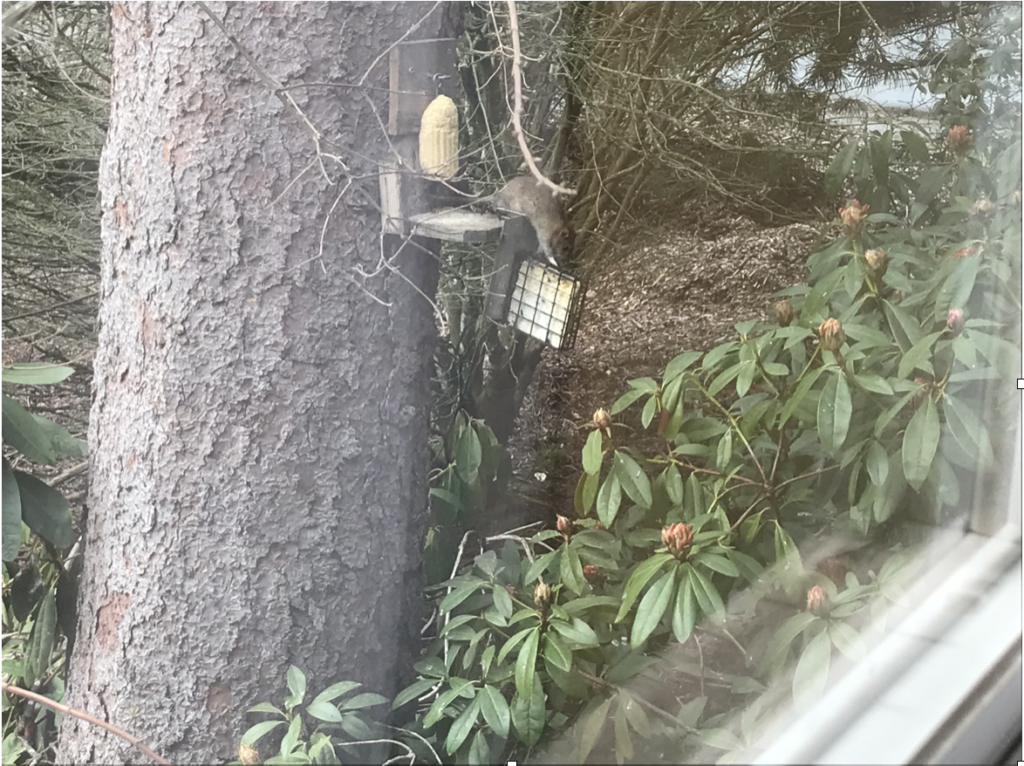
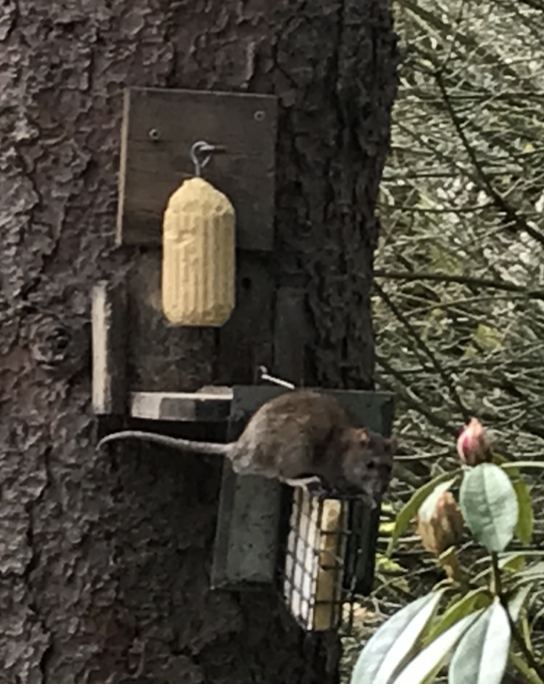
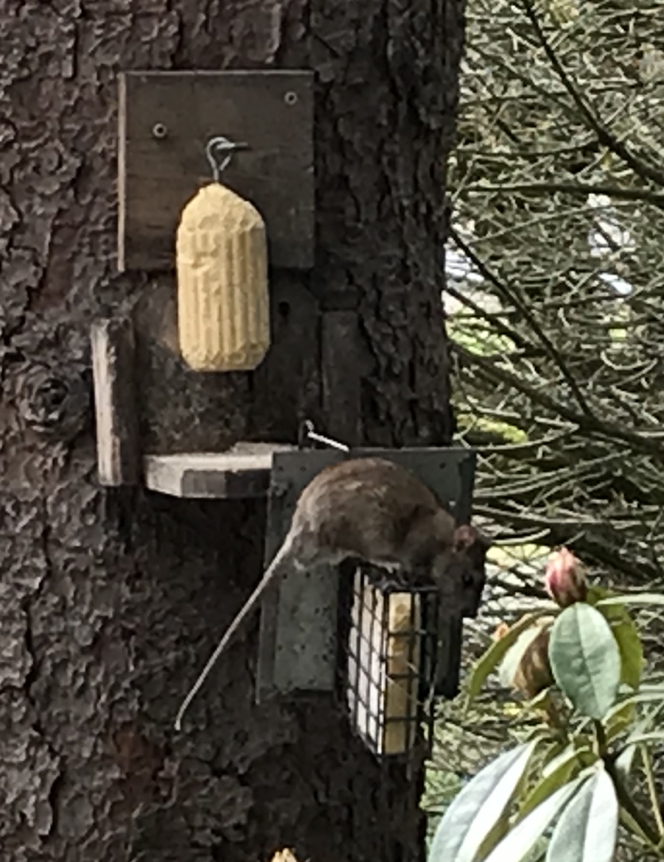
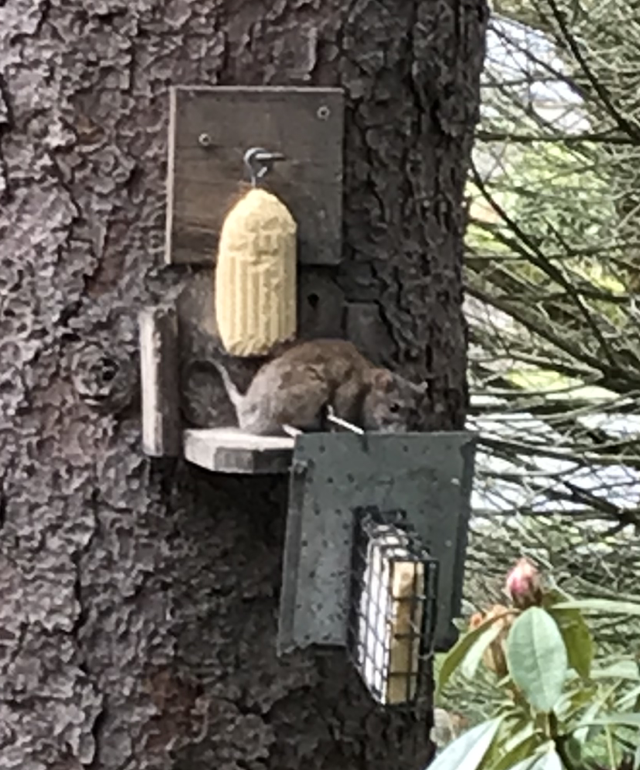
STORYSOLD: Great shots! I’m not surprised you saw him in broad daylight with that spread. Lucky rat for sure. Still hard to say about the identification. The black rats longer tail, bigger ears, and pointier nose are the main distinguishing characteristics that separate the species.
Quietly I was feeling pleased with myself. Katherine hadn’t discovered any signs of activity in her Homefront, yet there were clearly rats outside. If that’s not a testament to the effectiveness of a quality exclusion service, I don’t know what is.
A FEW WEEKS AFTER THAT >
KATHERINE: Check out Cedric (the rat).
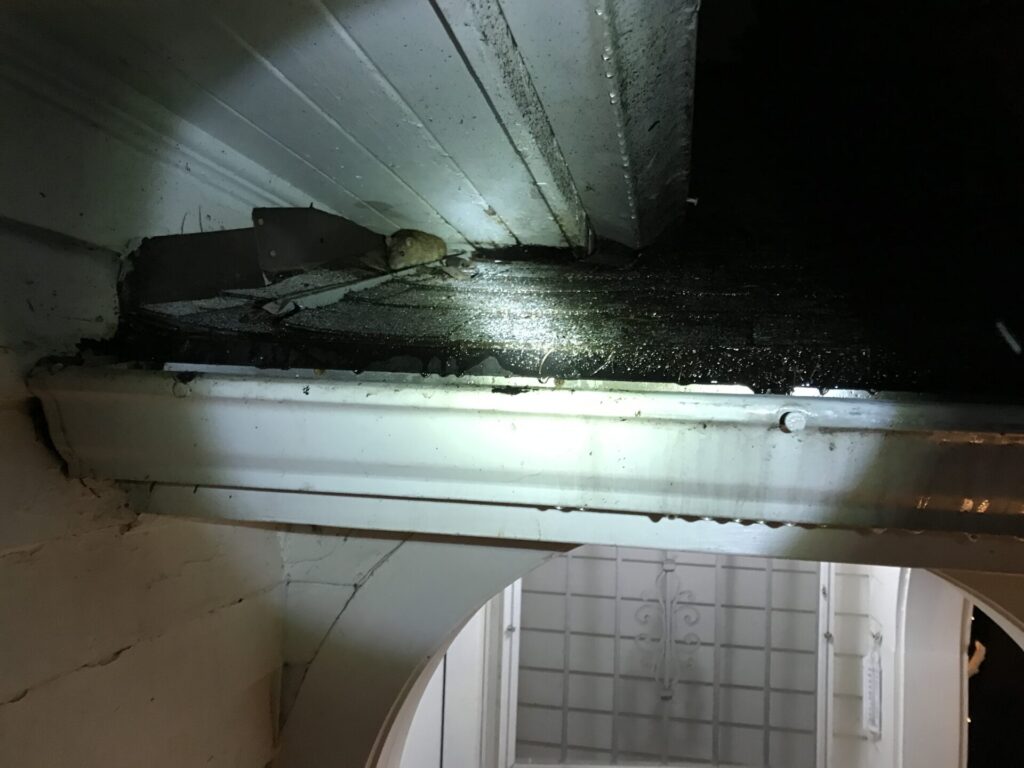
He is on our porch roof, just trying to get out of the heavy rain last night (or so he said). However, I see that he has pulled out a couple of pieces of roofing underlayment.
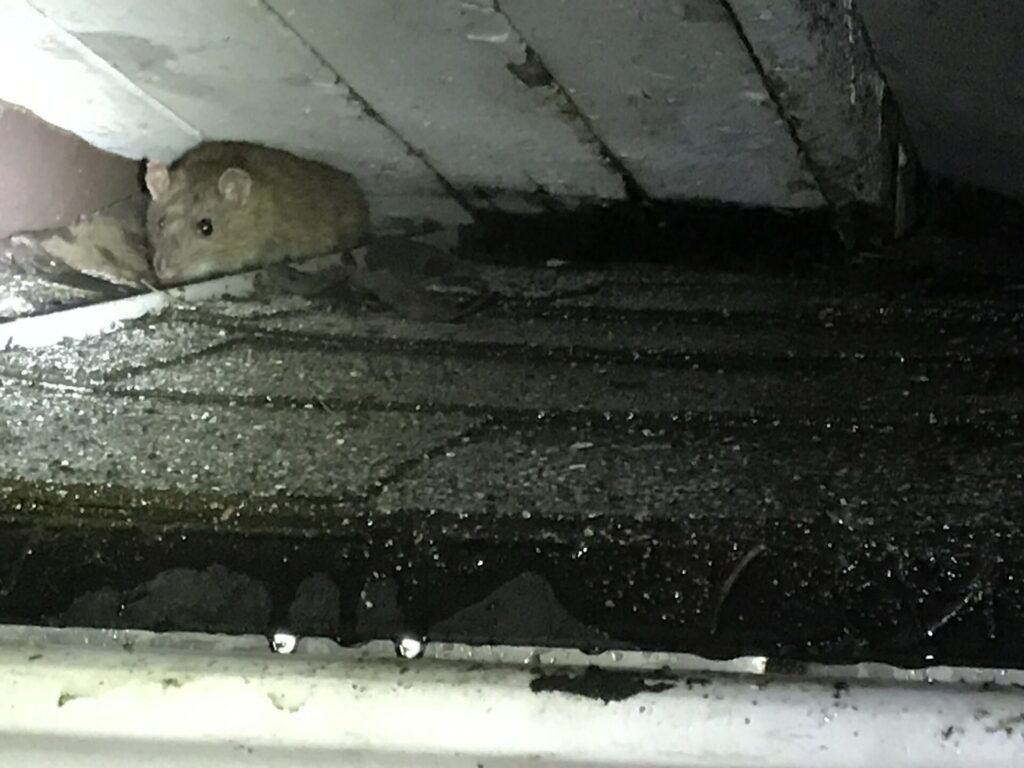
So I finally admit it’s time to alter our bird feeder arrangement…
So do you mind if we keep having your traps in our attic for a bit longer? (Do you want to charge us a little money for keeping them so long? I don’t know how many you have so please let us know when it’s time to give them back.)
STORYSOLD: That’s amazing! I’m constantly amazed how resourceful rats are.
KATHERINE: How did he know where to find that spot?
STORYSOLD: I guess it was close to the bird feeder. And yes, absolutely feel free to use the traps as long as you need them. My biggest worry is the same as yours. I want to make sure your home is secure.
KATHERINE: Thank you so much for your help! It is much appreciated.
In The End, I was proud to award Katherine with a Jr. Rat Catcher Badge. The only other human I’ve considered for this esteemed title is Llew, but Llew went a step further. As I read it, Llew became “Rat Catcher Llew” in the time they worked with me.
Naturally this award doesn’t come with a real badge, or money, or some other trite trapping of civilization. What it mean is, I recognize and celebrate Katherine’s wilder character. And it think it would be great is you humans, who also play your parts in The Earth Show, recognize and celebrate Katherine’s (and Llew’s) wilder characters too.
If you’re inspired by Katherine’s service story, you can recognize and celebrate her earning of the Jr. Rat Catcher’s Badge by owning her actions as your own:
As I read it, Katherine earned her Jr. Rat Catcher’s Badge by:
A: KNOWING (AND WRITING ABOUT) THE WILDER SIDES OF HER HOMEFRONT
B: ENGAGING HER WILD CREATURE FRIENDS IN THE SUPER REAL OF THE EARTH SHOW THAT EXISTS BEYOND THE FOURTH WALL OF CIVILIZATION, MEETING THEM WHERE THEY’RE AT INSTEAD OF SEEING THEM THROUGH THE LENS OF DISNEY ANTHROPOMORPHISM.
C: OVERCOMING THE CLASSIC FEAR OF RATS
D: WORKING TO SECURE HER HOMEFRONT, MAINTAIN GOOD TERRITORIAL BOUNDARIES, AND THUS KEEPING HER HOME SAFE FOR HER WILD CREATURE FRIENDS
C: MAKING A MIX CD OF HER FAVORITE SONGS ABOUT RATS
Thanks for the adventure Katherine! I will be knocking at your door with the zombie apocalypse hits and the rat hoards begin sweeping through our streets!
![]()

by Jake Wasson | Jun 3, 2023 | Season 3, Wilderness Security Guide
Welcome humans. I’m Wilderness Security Guide the Environmental Control Operator for STORYSOLD: Pest Control. This is a service story about what happens when humans feed my wild creature friends the raccoons like they’re pets.
Our story begins with a text from Farmer Rachael. She is a rockstar farmer in our human host Jake’s lifetime lover’s story Full Cellar Farm. She’s whip smart with a witty and warm sense of humor, has a degree in wildlife biology, married to a handsome cool guy who designs shoes named Evan, and recently became the mother of a new human named Stella.
FARMER RACHAEL: If there is a raccoon out and about during the day do you think it’s sick? There they are eating cat food and washing their hands…
STORYSOLD: Good video. I’m in NE [Portland], but I don’t have my wildlife traps. My guess is that it’s hungry…removing the cat food is best move 😹 The signs of disease are lethargy and aggression. So if it crashes on your driveway and doesn’t move, that’s bad. If it tries to eat your face, that’s bad too. I could spray coyote urine at it…
FARMER RACHAEL: It kind of freaked me out! It ran away when the mailman came by though.
STORYSOLD: That sounds normal.
FARMER RACHAEL: You think it needs to be trapped? Idk how I can convince my neighbor to get rid of the cat food. She thinks feeding the raccoon is good because its hungry.
STORYSOLD: This is a classic story. Removing cat food is the first suggestion I make when I talk to people on the phone. Joke’s on her.
FARMER RACHAEL: For real. Nothing good comes from feeding a raccoon. I just gotta be more careful in our backyard now during the day. I’ll try to tell her to not put out the food. Aw man I hate this kind of confrontation.
STORYSOLD: I would only trap it to keep it from being domesticated by the Disney humans. I should knock on her door like a cop and tell her that “there’s been reports.”
FARMER RACHAEL: I mean that’s tempting. I’ll track this little gremlin and see if it becomes a big problem.
STORYSOLD: Agreed. Let me know if I can shame or scare her into doing the right thing, or whatever 😹
FARMER RACHAEL: Right on.
That’s how this story began. We were joking about trying to shame or scare the Neighbor into doing the right thing. We knew from experience that was a bad idea. The story where humans feed the wild creatures of The Earth Show is a common, tragic, unfunny story; especially when the pet people cross over from feeding store bought domesticates to feeding of feral cats and then cross over to feeding birds, squirrels, possums, rats, and raccoons. Pet people are normal. Wilder pet feeding people like Birders are normal too. They’re reoccurring Earth Show characters. The names humans call the wilder pet feeding people aren’t always nice. Humans who other humans feel take the feeding of wilder pets too far are labeled with social character disorders like Pet Hoarder or Crazy Cat Lady. We don’t believe labels like those are helpful. We know from experience that shaming, scaring, and or trying to force a human who’s hosting an unpopular character to change doesn’t help anyone, ever.
So we’re going to try a different approach. Instead of pinning the Neighbor with some kind of individual based disorder or character flaw like a doctor, we’re going to show you where this character comes from and why we believe humans feed the raccoons.

We call this Earth Show character’s storyline, or plot, “The Wilder Pet Predation Plot.” Humans don’t know it yet, but someday soon we will begin to write and produce The Action of The Earth Show with a lot more intention, flare, and awareness of what we do. In that future, environmental control operators will use live action storylines and plots like The Wilder Pet Predation Plot and The Entry Hole Strengthening Storyline to “treat” (yes I hate that word) or edit The Earth Show like healthcare professionals use their diagnostic manuals filled with names and label to treat for their disorders/diseases. It will take a lot of time and hard work to persuade earth creatures that it’s not smart to try to “treat” the microenvironment of individual bodies without, at least, making a meaningful investment in making radical changes in the diseased/disordered vector’s macro environment. Macro-environmental control is the role classic pest control operators fill now, but they’re hopeless outgunned (in a socio-economic sense) by the healthcare system. It’s my hope to introduce Earth Show plots, like the one you’re reading now, in an attempt to show the pest control industry it’s potential, which is great and glorious and could literally help save our planet if done right.
In any case, back to reality. Here’s my working definition for this Earth Show plot…
THE WILDER PET PREDATION PLOT: The Action where humans unwean wild creatures in an effort to control, trap, and or kill them to protect their Homefront territories; or preserve their meat for future food production, or feel a sense of connection with The Earth Show.

Wildlife feeding stations at apartment complexes in Lake Oswego and West Linn.

I’m a wild character, so naturally I struggle to understand why humans delight in the feeding, sheltering, and environmental controlling of earth creatures (I do environmental control to hunt for cash, not for entertainment or comfort), but I deep down I Get It. It’s okay in the same way any horrifying mistake can be normalized in time. Big mistakes are like that. The daily sacrifices that are made to pay for the original big mistake tend to gang up on us. The sacrificial payments made to That Storyline make it feel like it’s meaningful–like it can be fixed somehow if enough effort is made–when, in fact, maybe it’s a storyline that should have been edited from The Earth Show a long time ago. All the philosophizing aside, all I’m trying to say is I Get It: wilder pet and pet predation, in general, has a place in The Earth Show.
My easy read goes something like this: normal household pet predation is okay because most pets owned by humans are born in captivity, stay in their Neverland state of domestication, and never know what it feels like to be wild and free and own their own parts of The Earth Show. For years I’ve asked Farmer Emily (owner of Full Cellar Farm) to describe the relationship she has with her pet Pip the Evergreen Jungle Cat. Outside of being a well-fed killing machine, Pip has no working role in Emily and Jake our Human Host’s Homefront. We don’t talk about this subject often (because of the strong feelings it produces), but I believe Emily’s pet ownership comes down to “I like Pip because his fur is soft,” and a general feeling of “comfort” that Pip brings to Emily’s story in spite of his daily run of asshole shenanigans.

It’s not only Emily who has strong feelings about pets. Most humans have strong feelings about pets. That’s why we strongly encourage you humans to stop reading now if you value your civil pet relationships, because we’re about to present something controversial:
I believe (based on my experiences as an environmental control producer of The Earth Show) that pet and wilder pet relationships are predatory.
In The Action, predators in The Earth Show don’t only hunt, kill, and eat their prey. Predators invest a lot of time and energy in the controlling, herding, tracking, and managing of their prey populations. If anything, The Hunt is a ritual given that unfolds like human wars and movies unfold with both predator and prey very aware of what’s going to happen next. For example, I know my rat populations. Nine times out of ten, The Hunt isn’t a contest. I win each and every time. Every so often I face a complex territorial Homefront where the rats have been there so long they have the advantage, but those service stories aren’t my normal, ritual, sacrificial rat catching experience. So yeah, what I’m trying awkwardly to get at here is: the primary working role of any wild predator is The Action of controlling the food, water, shelter, and story of their prey. That’s the hard work. The Hunt and the killing is a sacrificial ritual (or what modern humans call “sports”) and the after party howling at the moon and feasting are the moments of victory.
Humans control their soft fur bearing pets (comfort/entertainment/service creatures) by controlling their environment, supplying them with food, water, and shelter. Typically humans call creatures who take food, water, and shelter from us (without our permission) “pests,” and we call earth creatures who we love and give food, water, and shelter to “pets.” The rub there is, we inadvertently give most “pests” food, water, and shelter too. We do that by not controlling our territorial environments (what I call our Homefronts) in a way that draws clear boundary lines, writes clear wild markings, and speaks the universal language of The Action in a way that says, “Fuck off! You’re not welcome here!”
Raccoons and rats don’t understand English. So “fuck off!” has to be translated into The Action of not leaving any open entry holes into your Homefront, or leaving a free food supply around like–“The first hit is free!”–from an enterprising neighborhood drug dealer. The call and response of owning, marking, and becoming the apex predator of your Homefront is (or should be) an active, on-going storyline. Owning is, after all, an action. “Ownership” is a shitass power word that makes no sense to my wild creature friends. They know when the humans let their guards down and fail to produce The Action that’s needed to own their Homefronts. The wild creatures of The Earth Show are persistently producing The Wilderness Test, constantly testing “the fences” of civilization, ever exploring for new territories that no earth creature, animal or human alike, are actively owning…
It’s hard to translate the leaving of free food out as anything other than an open invitation. In the wilder language of The Action I imagine the free food scene translates into something like, “My Homefront is open for business! We killed a Cat Food Factory and we’ve already took our fill of the meat. Feel free to take your turn in the feeding line with the other scavengers.” In The Wilderness, apex predators tolerate lesser predators and scavengers. You could even say, in a way, they domesticate them. I imagine wolves do this, because a scavenging mouse, rat, raccoon, coyote, or wild dog whose always hanging around the pack’s kills make good meals in a pinch. Domestication (turning an entourage of scavengers into food pets and walking meat) is an apex predator’s inventive answer that meets the same need as our refrigerators. Packing, preserving, and protecting a supply of elk meat is a lot of unnecessary work. Apex predators aren’t lazy. They’re just smart.
Meanwhile, back to our service story. After Rachael tracked the Neighbor’s feeding of her wilder pet raccoon for a few weeks, this was her reply:
FARMER RACHAEL: Could you trap this raccoon? Would you let it go on the farm? How much? Sorry for the interrogation haha. I’m really on edge with it hanging around in the daylight.
STORYSOLD: Let’s do it! Can you spy and find out what brand of cat food it likes?
FARMER RACHAEL: Yes! I think we can put a trap on our garage.
Two days later, I arrived at Rachael’s Homefront after a long day of producing The Earth Show around the Portland area. The Neighbor and Rachael had already talked and they were both onboard with the trapping plan. The Neighbor was there to meet me when I arrived. The first thing I noticed was the cat food dish in the front yard and all the peanut shells littered around the porch like a country bar.
The Neighbor was warm and receptive to speaking openly about her feeding practices and wanted to do everything she could to deal with the bold day walking raccoon, agreeing to pay STORYSOLD: Pest Control for our help. At first I tried to see if she would be receptive to simply not feeding the raccoon. After a few moments of conversation I could see that she had a kind of cop mentality about the problem. “This isn’t a systemic problem ma’am,” I imagine the cop would say. “It’s just one bad individual raccoon who needs to be taught a lesson.” I might have entertained that storyline too, but we knew Farmer Rachael. Her family are regular supporting cast members of Full Cellar Farm and STORYSOLD: Pest Control. Her stories about the Neighbor who feeds the creatures of The Urban Wilderness had been featured at Full Cellar Farm for years, so I knew better than to think the raccoon was acting abnormally. In an attempt to curb the Neighbor’s pet predation scene, I described the raccoons behavior to the Neighbor using relatable words like “addiction” and explained it was normal for wildlife to become more bold, more trusting, more like pets, when humans feed them regularly. I also attempted to illustrate the kind of damage that’s done to a wild raccoon’s character when they become hooked on a regular food supply.
STORYSOLD: The most damaging thing you can do to a wild creature is to feed it, because they become hooked like addicts. They lose their ability to forage and hunt normally and they become upset and aggressive when their handout food supply is taken away.
Then I asked her point blank if she would stop feeding The Wilderness. She agreed it was a good idea, but she struggled with the idea of not feeding her feral cat friend.
THE NEIGHBOR: She (the cat) has been depending on us for years. We can’t abandon her now. What if I just put the food out for the cat and brought the dishes in after…?
STORYSOLD: The wild creatures you’re feeding will know that you’re still feeding the cat. They won’t stop coming around, at night, in the day, until they get their fix of free food. If you don’t stop cold turkey they might walk in through an open door, looking for the handout, or begin to approach other humans like Rachael and her newborn expecting the same pet like relationship you’ve developed with them. It’s normal for them to start act like pets when you feed them like pets.
The Neighbor listened and agreed to everything I said, but the conversation had a reset button and we continued to loop back to the needs of the feral cat. It took me a while, but I eventually realized that the feral cat was the stand in character for our conversation about the raccoon.
As I began to describe the trapping process to her, our raccoon appeared right on cue on the side of the stand alone garage. The neighbor normally fed her around two, and it was already four. Our buddy was eager for her afternoon meal and we were standing around, in her way, jibber-jabbering in Human speak, obstructing her from meeting the performance expectations of her routine afternoon storyline. My first though was to grab the trap and put her afternoon meal in the trap to see if I could catch her before I went home, so that’s what I did….

The raccoon found the food in the trap almost immediately. I watched amazed as she reached over the trigger paddle of the trap and took food from the dish with her very human like paws, scooping the food from the dish one handful at a time. When her meal was over, she sauntered back to the large evergreen tree in the back of the garage where she lived. Next in the Neighbor’s scavenging line was the feral cat, who appeared from behind the garage as well.
As I drove home that day, I wrestled with the inevitable ending of the Neighbor’s service story. Almost four years ago, Our Human Host Jake accepted an official state of Oregon business entry into their heart and began to host STORYSOLD: Pest Control. During that time I, as Wilderness Security Guide, have performed dozens of successful raccoon eviction and exclusion services all without trapping and killing our pesky wild creature friends. Until then, the only raccoons I trapped and killed were a part of the classic wildlife trapping services I performed when I worked as an employee in The Industry working for Pioneer Pest Management (the Thing now called PurCor). Amazingly, in the years Jake’s been hosting STORYSOLD, we hadn’t met many humans who fed The Urban Wilderness with as much panache as Rachael’s Neighbor; and I knew, in my heart, I wasn’t going to be able to break the raccoons addiction to civilization by spraying coyote urine on her, evicting her from a shed, attic, or crawlspace, or even writing an action plan to keep the Neighbor from feeding her. She was no longer independent and wild. She was an unweaned daywalker now.
For clarity, I imagined what would happen if I trapped her and relocated her at our fifteen acre farm in Boring, Oregon (with the permission of ODFW of course). The storyline in my mind always ended the same. The raccoon would show up at our front door at feeding time, or wander to our neighbors’ Homefronts and attempt to continue her pet like relationship with the humans she found there.
Here’s a chat snapshot of The Action that happened in the next few days…
FARMER RACHAEL: Nothing in the trap [in front yard] but it looks like something tossed around in the food awhile.
STORYSOLD: How about the other one?
FARMER RACHAEL: Where is the other one? I see the one in front by the tree. I see it [by garage] nm. Triggered with nothing inside, but some hair.
I was in the area, so I stopped by and reset the trap and asked Rachael to check them…
FARMER RACHAEL: Oh great! I’ll check on them again tonight. Maybe we will get him before his afternoon shift at the cat diner.
STORYSOLD: I think this guy understands traps. My guess is I get the feral cat first.
FARMER RACHAEL: Yeah dang.
STORYSOLD: I watched him yesterday fish over the trigger to get food.
FARMER RACHAEL: Omg no way! Wow. He [she] is seasoned. They are amazing.
STORYSOLD: The words I’ve been using is “domesticated monster.”
FARMER RACHAEL: He’s going to be a tricky one. Just saw him walking around. He ate all the food.
STORYSOLD: It will work so long as he doesn’t get food from anywhere other than the traps. I’ll just keep putting food in there.
I think that’s the part pet lovers don’t understand about what I do. Feeding the wilderness, for a rat catcher, is a predatory act for me. It’s not the brand of trap that catches a rat, or a raccoon. It’s doing what the Neighbor has already done. Successful trapping is about hooking my prey on the food, bait, or attractant I supply and control. Controlling food, water, and shelter is what environmental control operators do everyday. Killing the “bad guys” in The End is not as nearly as important as controlling and reclaiming the environment from the “bad guys.” In fact, it makes no sense to kill the “bad guys” without making the necessary changes to my customers’ Homefronts, because it’s not the gene for bad guys, or Satan, that makes bad guys. It’s an unbalanced relationship with The Earth Show that develops bad guys, which usually begins with a “good guy” who hasn’t marked and developed their Homefront in a way that produces The Earth Show scenes they want in their home. In other works, it’s not sexy…but being a good guy is about setting strong territories boundaries for your Homefront more than it is killing the bad guys that misread unset boundaries, or weak ones.
I know the Neighbor wasn’t thinking “I’m going to unwean these wild creatures, hook them on my food supply, and control their stories like a wolf managing its supply of elk meat.” The Neighbor was thinking what Disney (and civilization in general) wants her to think. The importance of weaning isn’t often valued in our modern domesticated world. Sure most humans stop nursing at the appropriate age (except the closet nursers), but the whole part where we “bite the tails” of our youths and push them out of the nest doesn’t always happen for many systemic reasons. Simply put, many human relationships are pet like: pastor/congregation, owner/employee, artist/audience, etc. I think that’s why so many humans own pets. It’s an affirmation of their fundamental relationship with The Earth Show. I’m choosing to resist my urge to go down the rathole on this one. Instead I’m going to cut this short and simply say, “Humanities primary predator characteristic is domesticating and controlling The Earth Show’s food, water, and shelter supplies, and we affirm our role as the planet’s apex predator by owning unweaned domesticates in our homes.”
“This is Fido, and I’m his human master Jake,” I would say if I were a dog owner. “I supply Fido with food, water, and shelter. He was taken from his mother soon after he was weaned. I like to think he still understands what it’s like to live wild and free in a pack of dogs, but that’s not the case. I train him to do tricks. Mentally Fido is still an adolescent living in The Neverland called domestication. He wouldn’t know how to write The Earth Show with a pack of wild dogs if his life depended on it.”
What the Neighbor was doing at her Homefront was as normal and common as watching a Disney movie with a bowl of popcorn in her lap. There’s an entire aisle at the supermarket dedicated to the feeding of our wild creature friends. The rub of her story was, she was mass producing The Wilder Pet Predation Plot in a way that spotlit this storyline more dramatically than an overflowing bird/rat feeder in the backyard. Domesticating birds (and rats) is damaging to their wilder characters too, but we don’t often see the damage it does…because they migrate we don’t have to face that reality like we do a once wild raccoon playing pet with a newborn baby present.
A few days later, The Action at the Neighbor’s continued…
FARMER RACHAEL: Today we caught another neighborhood cat and a possum. I reset them.
STORYSOLD: Yikes! I hope all this will convince her to stop feeding the wildlife.
FARMER RACHAEL: For real.
STORYSOLD: Thanks for helping!
FARMER RACHAEL: The possum is really taking his time coming out.


STORYSOLD: I’m coming by in an hour or so to get the possum.
FARMER RACHAEL: Ok. He might be out I will check. We moved the trap into a more secluded area so maybe he’d feel comfortable coming out. I will check again once Stella wakes up from sleeping on me.
Meanwhile my ongoing text conversation with the Neighbor was not going great…
THE NEIGHBOR: Jake, we have not seen hide or hair of our raccoon for the last 2 or 3 days. Can I feed my cat and we’ll see if he comes back?
STORYSOLD: No that’s a bad idea. Racoons have a foraging range of a mile in the city. The price of this story (for the good of you and your neighbors) will be your letting go of feeding any animals outside. There is no good way to target one animal for love and domestication without targeting the rest of the urban wilderness. Trust me, your wild cat friend will be better off if they don’t have the confusing prospect of a regular handout. There are so many rats to hunt out there!
THE NEIGHBOR: Oh, Jake, I wish I had understood your stance earlier. I don’t know that I can stop feeding Sage for good. I would be willing to feed and pick up the food so it isn’t always out, but I have been feeding her for a couple of years. I just don’t feel good about turning my back on her. I feel like crying right now. I had no idea this was where we were heading. It is only that one raccoon that comes in the day. I thought just getting rid of him was our goal.
STORYSOLD: I’m sorry if I upset you. I’m onboard with the goal of trapping the raccoon. I was mostly replying to the immediate needs of that plan. Leaving food out for the cat will make the trapping harder and more expensive than it is already. Even if you work to target feed the cat, the rest of the wildlife knows it. Trapping is only helpful if it breaks the behavior/addiction that was built up over years. Bold/aggressive wildlife is only a symptom of that storyline. Just trying to make our relationship as clear as possible: trapping the lead/most bold of them is difficult/expensive short term solution, but it’s better than doing nothing. I will support whatever decision you make. It is your home and you hired me to help, not tell you how to relate to The Wilderness.
THE NEIGHBOR: Thanks Jake. I understand what you’re saying.
I tried many times to guide and show her The Earth Show as I understood it. Wild creatures, including and especially feral cats, have amazing super powers that pets do not. They don’t depend on us exclusively for survival. That’s what makes them wild. The difference between a wild creature and creatures who choose to be pets be boiled down to one word: adaptability. Science likes to write wilder characters as having fixed instincts, but the wilder pets (the wilder pests) I encounter in my Earth Show adventures everyday demonstrate an amazing ability to adapt. It’s the wild ones who aren’t weaned that cause the biggest infestations…
All wild creatures have mothers, but wild mothers don’t show their love for their children by supplying them with food, water, and shelter for any longer than is necessary. Typically raccoons are weaned from their nest and capable of living independently from their mothers in 2-3 months (studies often vary on these numbers). Often they stay together as a family unit for up to a year before the litter separates and the kits go their own ways. One year. Not eighteen. Raccoons, on average, live for fifteen years. That means they spend roughly less than one fifteenth of their lives with their mothers. Humans, on the other hand, spend about a quarter of their lives with their schools and families before they are weaned from the nest in the high school graduation ritual. And even then, for many human youths high school graduation only signifies the flying from one nest to the next one.
It’s impossible to know, but it sure seems like raccoon mothers value their independence more than humans do. By that I mean they work hard to prepare their kits for The Earth Show, teaching and showing and guiding their litter from their initial pet-like dependency on them to maturity.
I often feel like I imagine a successful raccoon mother feels when I watch one of my wild creature friends living wild and free in The Action without any help from me. I think, “Damn! What a total wild badass!” I enjoy watching The Earth Show for that reason. There’s something magical and wondrous about watching my wild creature friends writing The Action independently.
I’m sure the same goes for the mother of the feral cat and the mother of the possum. I’m sure they’d be mad as hell at their children for getting hooked so easily and becoming the prey of a human who writes The Wilder Pet Predation Plot. “How could you?” I imagine they’d rage. “Did you seriously believe I raised you to become that human’s service animal? And don’t even say it! I didn’t work my ass off just, so you could play The Bad Guy and sacrifice your life for the short term security of an easy meal. Nuts to that garbage. I’m your mother and you will respect my weaning!”
I’m a guide. I’m not an expert. I don’t fix problems. I don’t answer all the questions. All I want from this transaction is for humans to wonder: What good comes the storyline where the apex predators of The Earth Show intentionally unwean my wild creature friends, welcome them in their Homefronts and make them your wilder pets, and then call STORYSOLD: Pest Control when the cop mentality kicks in and humans decide the lone “bad guy” being “too bold” is running amok?
All I’m saying is, is there anything more comically tragic than exterminating an infestation (killing wild creatures) while, at the same time, our customer is creating the next one?
We have a term for that. We call it “pet ____(rat, mice, roach, bedbug, you name it) populations.” Orkin know it well. They have the managing of pest pet populations down to a science.
If I’m honest about this service story, I’m mad as hell. And I didn’t do any work to wean that raccoon! Mostly I’m mad at me, because I wasn’t able to find a creative way of weaning that raccoon back to its normal, routine, classic wild and foraging Trash Panda character. I knew the raccoon’s addiction to the pet predator’s handouts had caused her story to become infested beyond what I was able to control with my bag of environmental control tricks…
Raccoons can and will eat everything under the sun. They’re true omnivores. They eat bees, voles, crawfish, seeds, birds, eel, turtles, corn, eggs, apples, beetles, wheat, walnuts, rats, oysters, human food waste (half eaten hot dogs, leftover pizza, and the crumbs from your bag of chips), and whatever else is on The Menu. You name it, and they will eat it. My question for smart psychologists everywhere is, “Why do omnivores become addicts?” Do those cat food factory producers add some kind of additive ingredient to cat food, or is it simply the outstanding customer service that turns a badass omnivore into a cat food addict? We know from experience, wild creature who suffer from cat food addiction go through all the emotional cycles of heroine addicts. They feel that classic fear that their next paycheck (cat food handout) might not come again; they feel rage when that fear boils over and they will DO ANYTHING to satiate their next fix (of cat food), and of course, for wilder pets who become hooked, the only earth creatures worth writing The Earth Show for would be humans, because they’re the only creatures on the planet who can supply their fix of Friskies.
The call came on Mother’s Day. Our human host Jake had spent the day with his family. Long story short, his mother suffers from dementia. She lives in a memory care facility in Beaverton, OR. His brother Ben (who owns/operates his piano tuning business from his home in Aloha) hosted their Mother’s Day gathering. All in all, it was a good gathering. Jake’s mom needed constant redirection–“Let’s sit and enjoy some food, mom (for the third time)”–but she was uncharacteristically calm and content when we dropped her off.
Our human was about to sit down with an adult beverage and watch the last episode of Succession, when the call came in…
THE NEIGHBOR (via text): The raccoon is in the trap as we speak!
STORYSOLD: Oh shit! Is the door closed behind them?
THE NEIGHBOR: Yes.
STORYSOLD: Ok I’m on my way. Do we want to continue trapping?
THE NEIGHBOR: Not at this time, but thank you…
When I arrived to “take the raccoon (as instructed by my ODFW license),” I did my best to be Mr. Customer Service with the Neighbor and Farmer Rachael when they met me in the yard. I performed the generic customer service scene (like we all do), but I was not happy.
I didn’t know she was a she until after I killed her. Not that that mattered much. The coyotes, turkey vultures, hawks, mice, and bugs on our farm didn’t care if she was a she or not. They picked her flesh clean in a week or so.
A few hours after I killed her wilder pet, the Neighbor texted asking for her feeding dishes back. The next day I gave them to Farmer Rachael when she arrived at the farm for work.

A week or so later, Rachael confirmed that it was back to business as usual at the Neighbor’s Homefront. The food dishes were out supplying free food handouts for the possums, raccoons, rats, squirrels, and feral cats of NE Portland.
I know I shouldn’t care. I’m an environmental control operator. I write The Wilder Pet Predation Plot for a living. Every day I wake up, go to work, and use that old ecological storyline to hook my prey on my food source (bait/attractant), and then use it to either evict my wild creature friends from my customers’ Homefronts or use my addictive food drugs to trap and kill them. I guess I’m generally confused why any human would start the wilder pet predation trapping process, and then pay good money to have a professional, like me, finish the job for them. I like money as well as anyone, but that seems odd. The strangest part is the part where the Neighbor believed (and still believes) that they’re helping my wild creature friends somehow.


That last line still haunts me. I’ve had it ringing in my ears for weeks: “I have thought about it a lot, and just don’t see a different outcome.” I think it rings because it rings true.
I don’t know how to feel about this. I suppose I relate. Like the Neighbor, I don’t think of myself as the villain. I’m the helpful pest control operator. I love my encounters with wild creature friends as much as the Neighbor does, and I only kill when I have to kill. You know, when an individual/criminal runs amok and there’s no bringing them back into the fold of The Wilderness. I’m like a doctor who carves out a disease, disorder, or pest from The Earth Show environment, but I don’t cause, or participate in the creation of infestations. That’s what villains do. That’s what the pests themselves do. Yeah that’s it! In The End, it’s the raccoons fault for getting hooked on cat food. That has to be the answer, because that’s the only story that makes this make sense.
With that said, we the characters of STORYSOLD: Pest Control would like to wish all the hardworking weaning mothers of The Earth Show a happy mother’s day everyday. May you keep your kits, litters, and children safe from predators…
We may be the villains, but we’re still rooting for you!